

Avatar Tip Technology
Clinical Problem
The greatest shaping risk is concentrated in the apical third, especially in the final 2 mm.
This is where:
- Canal curvature is most likely to redirect the file away from the original path
- Dentin thickness is reduced and tolerance for error is low
- Transportation, ledging, zipping, and loss of working-length control become clinically consequential
- A more aggressive tip can engage the outer wall before the file is fully centered
In this zone, tip geometry matters. A file that cuts forward too readily can straighten its path, increase lateral wall stress, and compromise apical control.
TransformX Solution
Avatar Tip is the TransformX apical geometry designed to improve control where anatomy is least forgiving.
Its purpose is not to make the file more aggressive. Its purpose is to help the file:
- Enter curved anatomy progressively
- Stay centered within the original canal
- Reduce abrupt wall engagement
- Advance with better control through the apical constriction
This is a guidance-focused tip design intended to preserve preparation flow rather than force a straighter path.
Why Avatar Tip Is Safer Than Many Major Competitors
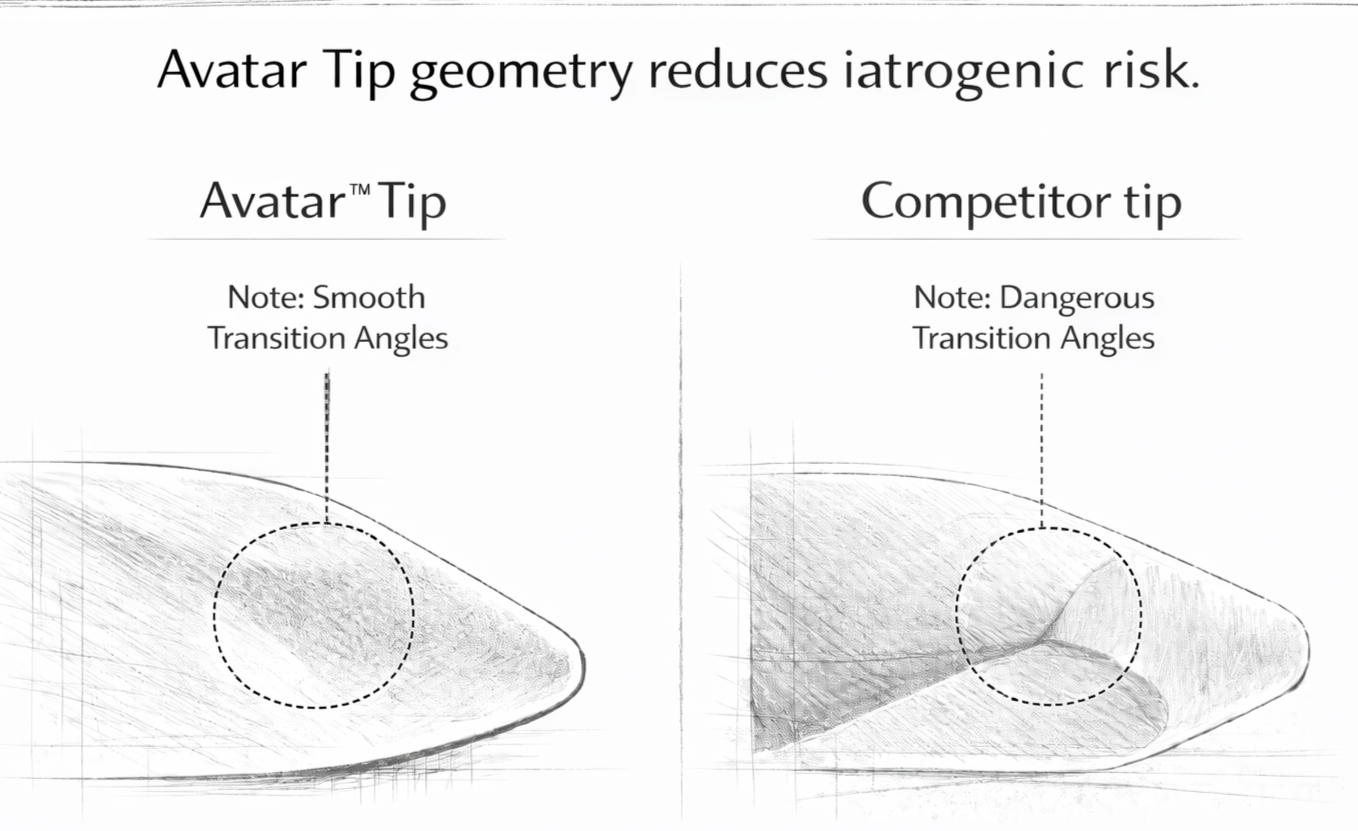
In direct tip comparison, Avatar Tip presents a smoother, more rounded leading profile than the sharper, more faceted geometry seen in many conventional competitor designs.
That difference matters mechanically:
- A rounded guidance profile is less likely to spear into the outer wall at first contact
- A smoother transition from pilot tip to flute supports controlled advancement instead of abrupt engagement
- Reduced transition-angle aggressiveness helps the canal reorient the file through curvature
- Less forward-cutting behaviour supports safer shaping in the zone where ledging and transportation begin
Video Comparison
Section titled “Video Comparison”The Apical 2 mm: Controlled Traversal Through Complex Anatomy
The most important behaviour is not simply how the tip looks under magnification. It is how the file behaves as it traverses a complex apical pathway.
In the bi-conical block demonstration, Avatar Tip shows a controlled pattern of movement through the apical segment:
- The file remains centered as it approaches the constricted region
- Entry into the final 2 mm is progressive rather than abrupt
- The tip appears to guide the file through curvature instead of driving it into one wall
- Canal centering is maintained while the file continues apically
This is the mechanical basis of the Avatar safety story. Safer shaping is not just lower aggressiveness at the tip. It is better guidance through the part of the canal where procedural error is most likely.
Apical Behaviour Demonstration
Section titled “Apical Behaviour Demonstration”Key Features
1. Rounded Guidance Profile
Section titled “1. Rounded Guidance Profile”The leading edge is engineered for controlled contact, reducing the tendency to gouge into the outer wall at the start of apical engagement.
2. Smooth Transition Geometry
Section titled “2. Smooth Transition Geometry”The transition from the pilot tip to the cutting flutes is designed to moderate sudden cutting engagement and improve file guidance through curvature.
3. Bi-Conical Tip Behaviour
Section titled “3. Bi-Conical Tip Behaviour”The geometry supports canal reorientation of the file during progression, helping the instrument stay centered as curvature intensifies.
4. Controlled Apical Advancement
Section titled “4. Controlled Apical Advancement”Avatar Tip is designed to preserve a smoother preparation flow through the apical third, especially when the final millimeters are narrow, curved, or anatomically demanding.
Clinical Benefits
Avatar Tip is designed to support:
- Better canal centering in the apical third
- Reduced tendency toward transportation and ledging
- Lower risk of abrupt lateral wall engagement
- More controlled approach to working length
- Improved preservation of the original canal path
- Greater confidence in difficult apical anatomy
Support From Tip Design Research
A crown-down tip design study published in the Journal of Endodontics compared files that differed primarily by tip shape.
The practical findings align closely with the Avatar concept:
- Biconical tip files produced the least transportation
- Biconical tip files produced no ledges in the study
- Sharper pyramidal designs produced the most transportation, ledging, and instrument damage
- The authors concluded that biconical tips maintained the original canal curvature better than conical and pyramidal alternatives
This matters because crown-down shaping depends heavily on what happens at the tip. When the tip guides through curvature instead of cutting forward aggressively, the file is better able to stay centered and preserve the intended canal form.
The Biological Relevance of Apical Precision
Ricucci and Siqueira showed that healing outcomes are most favorable when treatment remains controlled near the apical terminus rather than extending through it.
For Avatar Tip, the implication is clear:
- Mechanical control in the apical third is not only a shaping issue
- It supports biologically disciplined treatment
- A tip that helps the file remain centered and advance progressively contributes to safer termination
Integration with Transform Technology
Avatar Tip works with Transform Technology to create a more complete curvature-management system.
Together, they provide:
- Metallurgical adaptability along the file length
- Guidance-focused tip behaviour at the apical end
- Lower restoring-force consequences in curved anatomy
- Better control from coronal access to apical finishing
Reference Summary
- Ponce de Leon Del Bello T, Wang N, Roane JB. Crown-Down Tip Design and Shaping. Journal of Endodontics. 2003;29(8):513-518.
- Ricucci D, Siqueira JF Jr. Apical limit of root canal instrumentation and obturation in teeth with necrotic pulps and apical periodontitis: histologic analysis. Oral Surgery, Oral Medicine, Oral Pathology, Oral Radiology, and Endodontology. 2011;112(6):825-842.
Next: Transform Technology →